
IQ
Insight
Quarterly
Q3 | 2026

The used market: Performance remains stable despite increasing levels of supply











The used market continues to follow a steady, stable path, with our used car forecasts anticipating 2026 closing out at over 7.8 million transactions. Demand remains consistent, however activity lags behind that which we are seeing in the new market, with fewer used vehicles sold per new vehicle registered. Last year, the new to used ratio averaged 3.86 to one, dropping slightly in 2026 to 3.54 to one.
As always, dynamics within the new market echo into the used. Household budgets remain tight, lengthening ownership cycles for some, while discounts, low-cost models and tactical registrations result in some buyers from the used market being pulled into the new.
Tactical registrations are having a pronounced impact on certain segments in the new car market. 48.5% of the volume we identified as a tactical registration in September came from five marques alone, with one model alone accounting for 6.7% of these numbers.
Used supply is continuing to grow as we are beginning to see the long-term impact of 2023’s boom in fleet registrations play out in the used market. That year, we saw new car registrations increase by 17.9% year-on-year, with fleet registrations up by 37.8%, creating a significant volume that is now finding its way into the used market today, as forecast in our last edition of Insight Quarterly.
Encouragingly, we have seen improving performance of electric vehicles (EVs) in the used segment, especially as the 2023 stock uplift contained a significant portion of EVs (over 310,000). This is good news as many in the market were anxious to see how these vehicles would perform as supply begins to increase. Within Manheim Auction Services, we have seen a 50% increase in EV disposals, but first-time conversion rates are currently trending at 93%, compared to 86% for internal combustion engine vehicles and the residual value gap is closing.
So far, the increase in supply has been absorbed by the market, largely supported by the positive performance of used EVs, while the impact on pricing and conversion rates has so far been limited. However, pressure will continue to build in Q4 in line with increasing supply, coming to a head in early 2027.
Residual values
Discussions around residual values have shifted in recent months to a more positive view, especially considering the picture the growing rate of supply would paint. This is particularly true for EVs, where we have seen the gap between these vehicles and combustion vehicles narrow in recent months. In February, the average used internal combustion vehicle, aged between two to four years, retained value 23pp higher than EVs, which shrank to 13pp in September. We do anticipate that this trend will continue into the new year, as pressures lie elsewhere in the market.
Despite this, we do anticipate softening of values as we move closer to the end of the year. The risk to values is greater by brand and powertrain, rather than a market-wide decline, and the outlook could shift significantly dependent on a multitude of factors. For instance, looking at new entrants, new car pricing, finance deals and extended battery warranties are setting the reference point for used values. Whether those warranties and carry through to the second owner will shape the appetite for these vehicles in the new market.
Further, a significant portion of the nearly-new supply is petrol-led, with electric only accounting for 20.1% of these pre-registered vehicles. This means pricing pressure is more likely to land on mainstream, small petrol models than on EV models.
This short-term pressure means stakeholders responsible for pricing need to act fast. Appraisal accuracy and sharp reserves are increasingly crucial as supply builds.

Future considerations
While the used market has so far absorbed increasing volumes of supply, the longer-term implications of today's new-car market are only beginning to emerge. The next phase of the used market will be shaped by a more fleet-heavy and increasingly electrified flow of vehicles entering circulation. As larger volumes of EVs and fleet returns begin feeding into the market from 2028 onwards, stakeholders will need to place greater emphasis on procurement discipline, pricing accuracy and stock selection.
At the same time, the growing presence of Chinese brands presents a new challenge for valuation and risk management. Unlike more established manufacturers, many of these brands have limited residual value history, making future performance harder to predict. This uncertainty is particularly important because resale value remains one of the most significant concerns among older buyers. How these vehicles perform in the used market, alongside factors such as warranty transferability, future tariff decisions and manufacturer pricing strategies, will play an increasingly important role in shaping buyer confidence and long-term residual values.
Used car forecasts
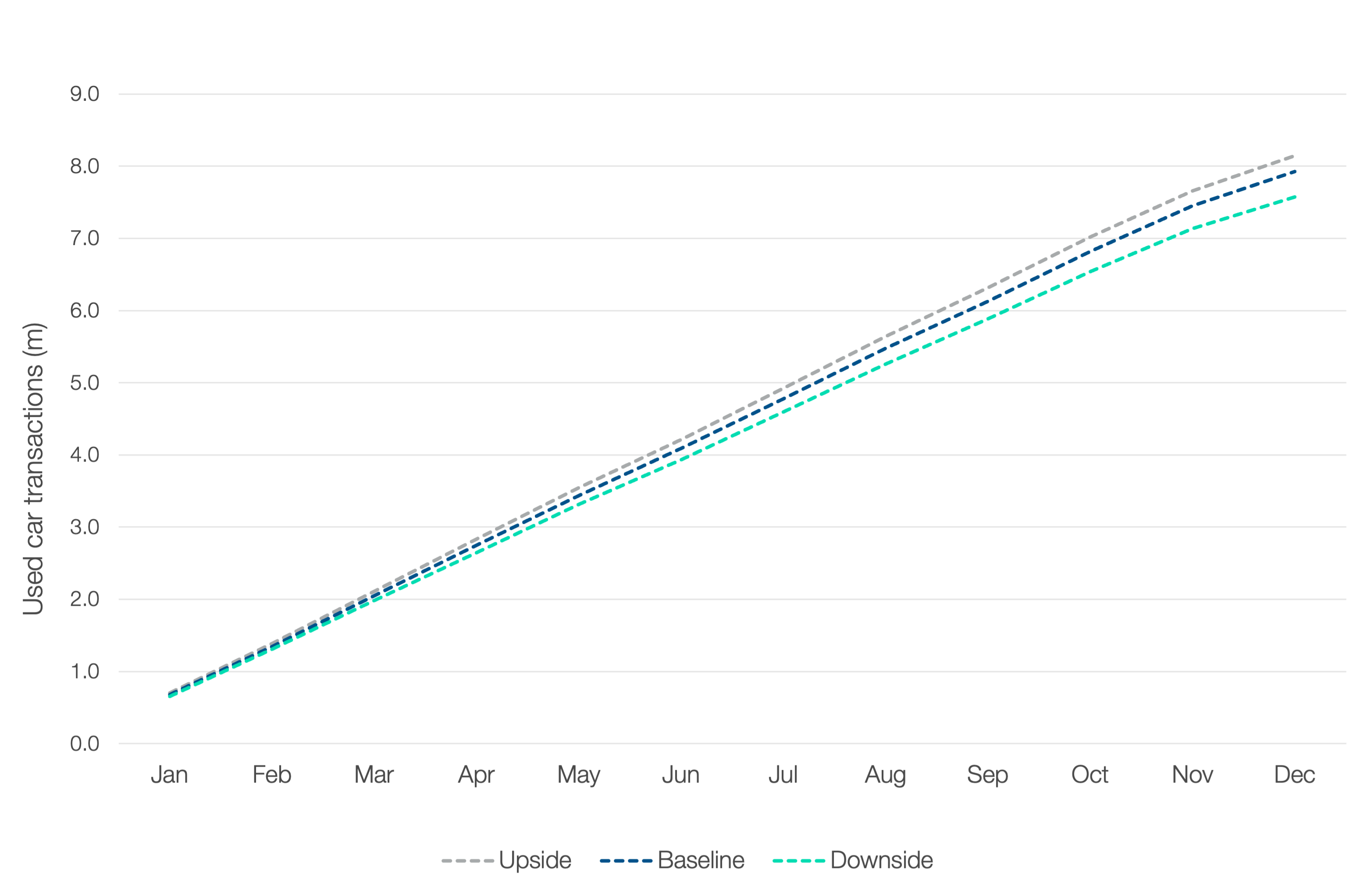
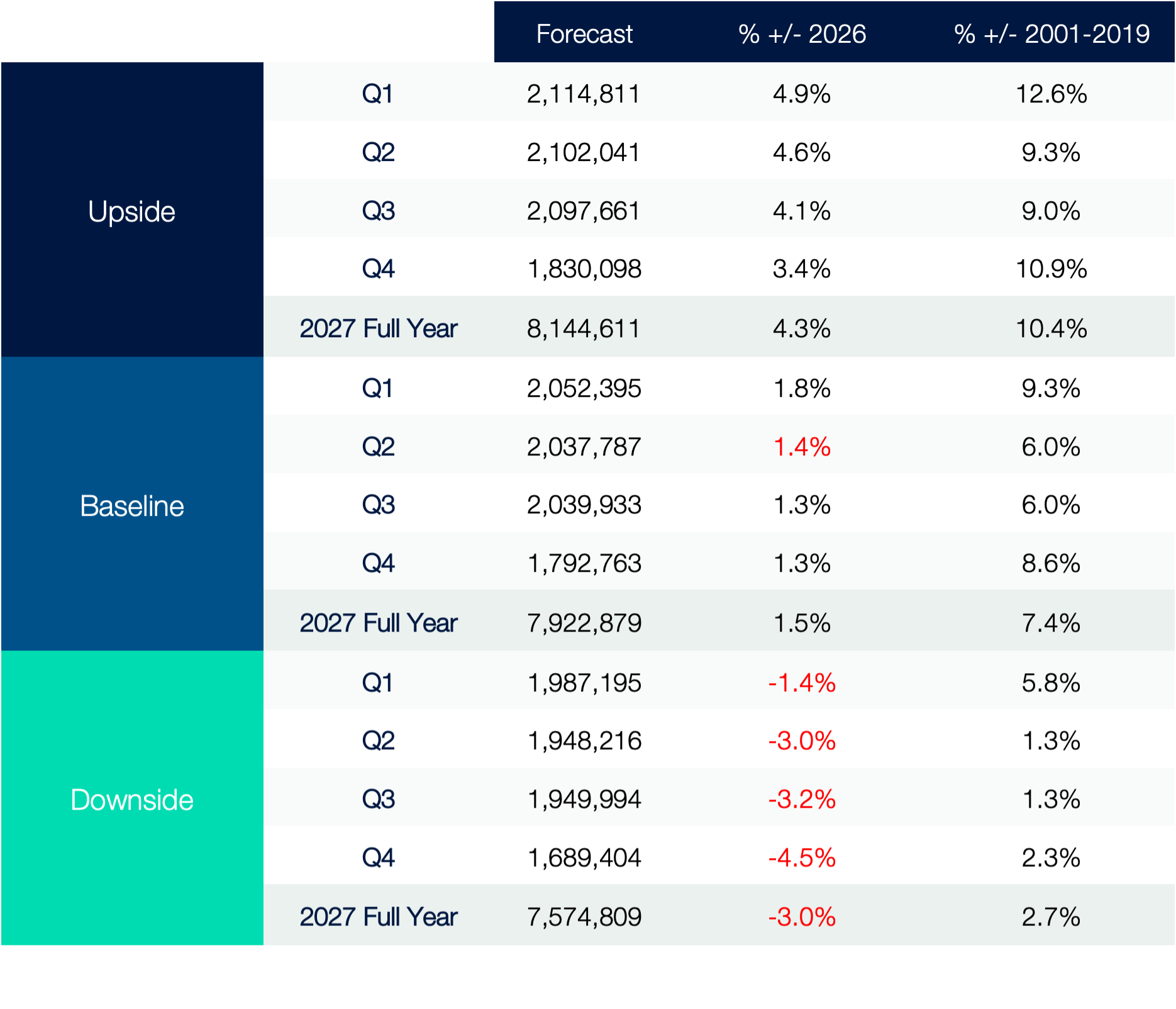
This quarter's forecasts sit against a used-car market that remains remarkably resilient despite a steady increase in supply. Our baseline scenario remains the most likely outcome, forecasting used-car transactions to reach 7.92 million units in 2027, a 1.5% increase on 2026 and 7.4% above the long-term 2001-2019 average. While transaction volumes remain stable, margin pressure is expected to increase as supply builds and affordability remains the primary driver of consumer purchasing decisions.
A more optimistic scenario sees transactions rise to 8.14 million units, a 4.3% increase on 2026, supported by stronger consumer confidence, improving affordability and continued positive performance from used EVs. Conversely, the downside scenario assumes renewed inflationary pressure, more aggressive discounting in the new-car market and weaker consumer demand. Under these conditions, transactions would fall to 7.57 million units, a 3.0% decline on 2026, although volumes would remain above the long-term market average, underlining the enduring structural importance of the used-car sector
Used Car Transactions Forecast 2027
Source: Cox Automotive
Upside scenario
In the upside case, used remains the retailer profit and cash engine, with demand strong enough to absorb the 2027 stock wave without destabilising values. Volume reaches 8.14m in 2027, up 4.3% on 2026e and 10.4% above the 2001-2019 average.
Consumer confidence holds as inflation peaks and rate cuts come into view, easing affordability pressure. Lower stocking and finance costs support margins.
BEV demand holds. First-time conversion stays ahead of ICE, and the ICE-BEV value gap stays narrow rather than widening, as rising BEV disposals are absorbed.
Supply stays manageable. Manufacturers ease off tactical registrations, the 2023 defleet cohort is absorbed, and shorter contract lengths give a more predictable flow.
Dispersion stays contained. Warranties carry across to second owners, the thin Chinese-brand residual history begins to fill in, and any new-car tariff firms used values.
Dealers keep prioritising used, using accurate appraisals and tight reserves to protect margins. Used grows more slowly than new, so fewer used cars are sold for every new one, but volume still grows.
Baseline scenario
In the baseline view, used stays stable but flat, with margins under sustained pressure as supply builds into subdued affordability. Volume reaches 7.92m in 2027, up 1.5% on 2026e and 7.4% above the 2001-2019 average.
Used volumes move only marginally. Rates on hold and soft consumer confidence keep affordability, not choice, the main driver of purchase decisions.
Supply builds as expected: three-year-old returns, defleet and tactical stock. Pressure lands on nearly-new and mainstream petrol small cars first, while BEV values hold.
Dispersion, not decline. Values diverge by brand and derivative, Chinese-brand residuals stay unproven, and funders price cautiously.
The fleet-origin feedstock gets heavier and more electrified from 2028, and the ZEV review outcome sets its scale. Any tariff adds a second unknown to Chinese-brand residuals.
Seasonality is unchanged, with Q4 softest and December the weakest month. Margin protection depends on procurement discipline, stock-ageing control and appraisal accuracy.
Downside scenario
In the downside case, affordability pressure intensifies, and heavy new-car discounting pulls demand away from used, increasing volatility in pricing and margins. Volume falls to 7.57m in 2027, down 3.0% on 2026e but still 2.7% above the 2001-2019 average.
Inflation re-emerges more forcefully than the Bank's central case, keeping rates higher for longer and weakening both consumer and business confidence. Used falls by less than new, because used follows new with a lag.
Heavy new-car discounting, entry-level offers and a price war exported from China accelerate the erosion of used sales into new, faster than the baseline assumes.
Rising used BEV volumes, new-entrant stock, and tactical registrations meet weaker demand, widening dispersion and exposing brands with no residual history.
Days to sell extend and stockholding costs rise, particularly for below-standard stock. A tariff or policy shock adds a second unknown to Chinese-brand residuals.
Margins are squeezed hardest at the bottom of the quality spectrum, with clean, in-demand stock the only reliable protection left.
Used Car Transactions Forecast 2027
Source: Cox Automotive
