
IQ
Insight
Quarterly
Q3 | 2026

New car market: Growth in the market is substitution, not expansion











The UK's new car market has continued to exceed expectations in 2026, with registrations reaching record levels. However, beneath the headline growth, the recovery remains concentrated in a relatively small number of brands and vehicle segments.
The latest data from the Society of Motor Manufacturers and Traders (SMMT) shows that year-to-date registrations are up 10.2% compared to the same time in 2025, with September alone up 12.1%. We are currently on track to end the year with a total growth rate of 9.3% and over 2.2 million registrations. Private registrations are also showing signs of improvement, accounting for 40.0% of registrations by the end of September, 12.0% higher than 2025, easing the fleet-heavy mix we’ve seen in recent years.
Analysing the make-up of the new market’s growth, Chinese brands are responsible for driving a significant portion of this growth. In 2026, they have registered over 300,000 vehicles between them and now occupy 17.5% of the new car market, quite the jump from 9.7% in 2025. What were once viewed as challengers are now firmly established participants in the UK market, and the established brands competing with them in the same segments are feeling the intensity of this competition. The three Chinese brands winning in 2026 on volume so far are BYD (68,405 registrations), MG (78,930 registrations) and Chery Group (123,626 registrations across its core brand and Omoda Jaecoo), with the long tail of smaller entrants operating at lower volumes.
These new brands are winning on several frontiers. We are seeing a greater willingness among younger drivers to switch brands, giving these manufacturers a route to market and then converting prospective buyers with lower price points, advanced software and compelling finance and warranty packages. Consumer choice is anticipated to grow further, which is likely to intensify competition further and increase pressure on established manufacturers trying to defend share in core volume segments. New brands are expected to exceed 100 by 2030 and marques including Denza, Freelander, Lepas, Nio, Xiaomi and Zeekr all set to launch in the UK in the not-too-distant future.
It is important to frame these market gains as substitutions, not growth. While they experienced positive results in 2026, it was at the expense of some established players, as brand share beyond the Chinese contracted by 2.7% this year.
Electrification has also contributed to growth. BEV and PHEV registrations continue to benefit from manufacturer incentives, policy support and favourable running-cost comparisons. However, demand remains heavily influenced by these interventions rather than developing entirely organically. Mandate pressure is pushing manufacturers to price electrified products aggressively and the ongoing Electric Car Grant has also helped support this, now extended to continue into 2029. Further, ongoing fuel price pressure is driving more consumers to consider electric, as headlines have shown diesel prices exceeding 200p per litre in some parts of the country.
The performance of the market, while trending above averages, is following usual seasonal patterns. September is always a peak month, driven by a volume of plate change stock, and usually accounts for around one-seventh of annual registrations. The market then settles into Q4 and quietens in the run up to December.
Despite this, September’s peak was driven heavily by a surge in tactical registrations at the end of the month. Advertised nearly-new stock on the September plate is up 37% when compared to the same period last year. This activity is also highly concentrated, excluding the single largest retailer group registering these vehicles, this pool of vehicles is only up 12%.

Short term impact
Taken together, these factors create a complicated market to navigate for retailers. For those who have taken on new brands, volumes are increasing, however established franchises are facing increasing pressure. Funders are also having to set values for these new models with very little residual value history or data to benchmark against.
The window for partnering with these groups is also closing. Despite the new brands set to arrive in the UK in the next 12 months, groups that waited to partner with these brands are finding open points in the market scarce. Both Omoda Jaecoo and BYD now have over 140 showrooms each, with Chery targeting 120 by the end of the year. Further, many of the later arrivals aren’t performing at quite the same rate as the earlier entrants.
Finally, tactical activity is concentrating in a few large, franchised groups, so the pressure on nearly-new stock will be uneven, squeezing independent brands.
Future considerations
2027 will see the UK new car market enter the next phase of its transformation, with several key dynamics set to play out. While established brands continue to defend their market share, we are already seeing new entrants competing with one another, shifting strategies to take share from each other as market saturation continues. This may give some retailers pause for concern when backing brands that may be likely to consolidate. In addition, it is likely that the true test of new entrant residual values will be seen next year, as volumes of fleet stock enter the used market.
The UK government’s decision on how tariffs will apply to these new brands could be the swing factor for 2027 market share, as ministers are reportedly ready to match the EU levy of up to 45% on these brands.
With fleet registrations declining from its recent peak, the feedstock of the remarketing industry is set to shift from around 2029.
What are key dates the automotive industry should be factoring into their planning?
As we end 2026 and move into the next year, the automotive market is set to be punctuated with several key dates, vital for any stakeholder’s planning:
- 23 October – The ZEV Mandate consultation closes
- 28 October – UK government announces its Autumn Budget
- 20 November – EU-UK Summit takes place
- 1 January – Fuel duty will rise to 55.95p per litre
- 1 January – Rules of origin changes come into effect
- Dates to be confirmed – UK tariff decision on Chinese EVs
These decisions could have significant impact on the way vehicles are manufactured, retailed and marketed in the UK, especially if collaboration with the EU strengthens and we see the government look to apply more of Europe’s regulations into our market.
For the electric vehicle (EV) market, these regulatory decisions could have a significant impact. The ZEV Mandate review may alter the trajectory of EV adoption, with potential revisions ranging from more flexibility on meeting targets to bringing PHEVs into scope. Further, the Autumn Budget will confirm to what extent support for EVs will be maintained.
New car market forecasts
Each quarter, we integrate proprietary market insight with the latest registration data to produce three 12-month outlooks: upside, baseline and downside. These scenarios reflect differing macroeconomic, policy and industry assumptions, providing a structured framework to support stakeholder planning across a range of potential market outcomes.
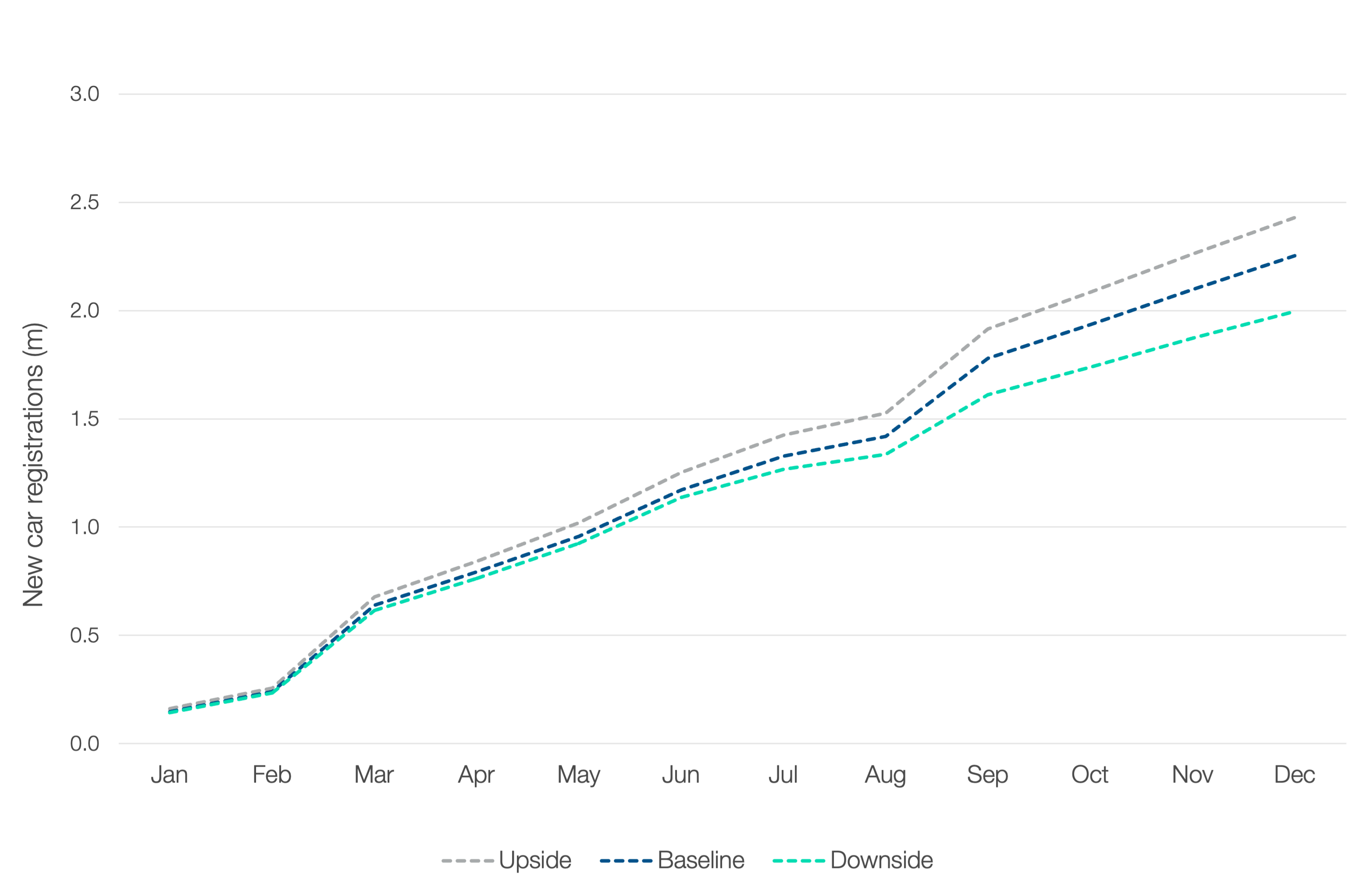
This quarter's forecasts are set against a market that continues to deliver strong registration growth, but where competitive dynamics are shifting rapidly beneath the surface. At the same time, the market is approaching a critical transition point. Our baseline scenario remains the most likely outcome, forecasting registrations to reach 2.25 million units in 2027, a 2.7% increase on 2026 and broadly in line with current market conditions. Growth continues, but remains concentrated among a small number of high-performing brands, while discounting and tactical activity continue to support volumes.
A more optimistic scenario sees registrations rise to 2.42 million units, a 10.7% increase on 2026. This outcome assumes easing inflationary pressure, improving consumer confidence, supportive policy decisions and a broadening of demand beyond today's key growth brands. Conversely, the downside scenario assumes a combination of renewed energy market disruption, weaker consumer confidence, adverse trade developments and policy uncertainty. Under these conditions, registrations fall to 1.99 million units, a 9.0% decline on 2026.
New Car Registrations Forecast 2027
Cox Automotive
Upside scenario
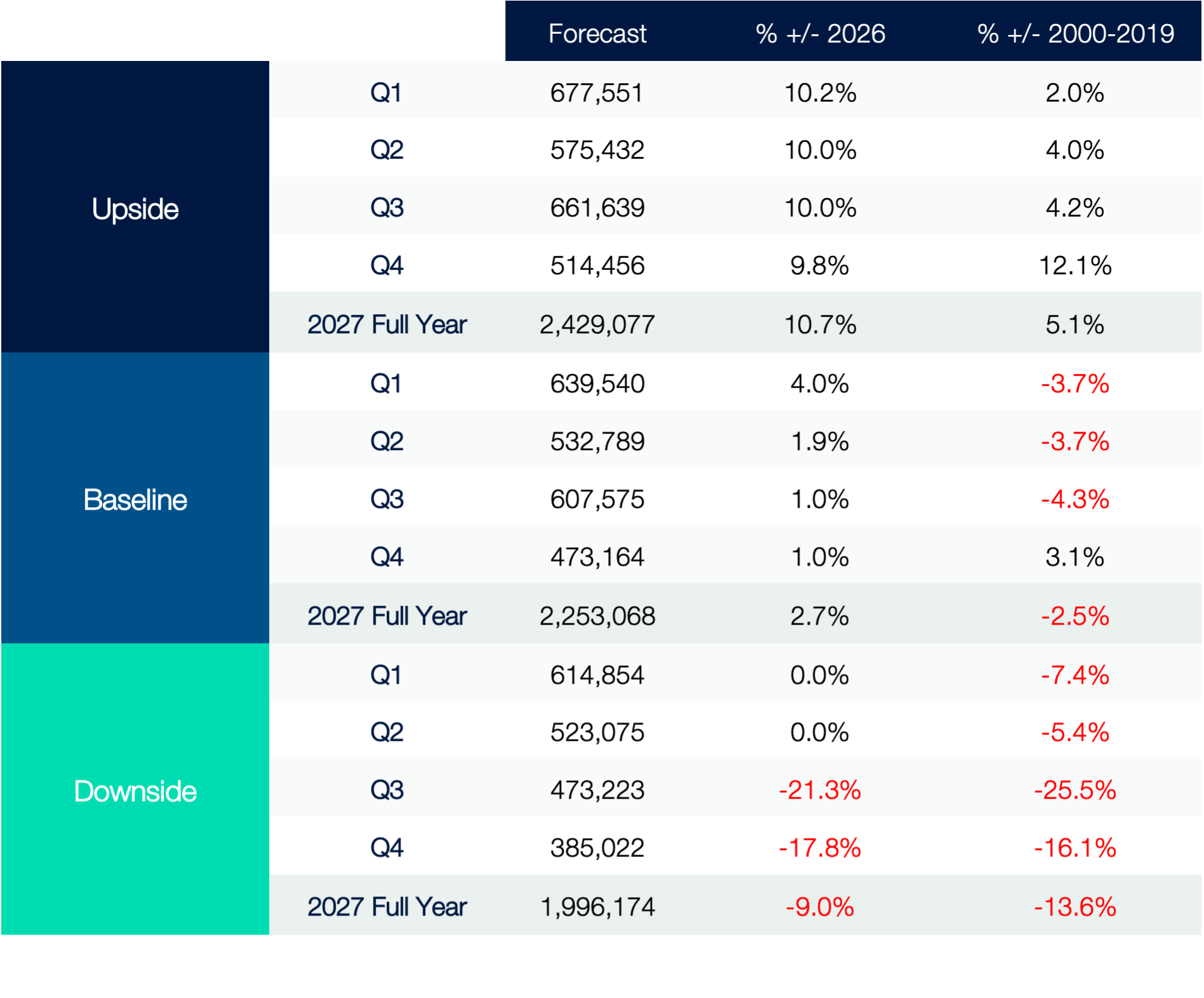
In the upside case, the energy shock fades, the policy and trade questions resolve in the industry's favour, and growth broadens beyond a small group of Chinese brands. The market reaches 2.429m in 2027, up 10.7% on 2026e and 5.1% above the 2000-2019 average.
Energy prices ease, inflation peaks below the Bank's central path and falls through 2027, and rates hold before cuts begin in the second half. Consumer confidence keeps building from its current two-year high.
The ZEV Mandate review concludes in early 2027 with targets manufacturers can plan against, the Budget protects EV support, and the Electric Car Grant runs on. OEMs plan for the 2028 step-up rather than discount their way through 2027.
Tariff and 'Made in Europe' pressure is contained: any UK duty on Chinese EVs is delayed or phased, the 1 January rules-of-origin step is absorbed, and the next wave of entrants launches.
Growth broadens beyond a small group of Chinese brands. Private demand recovers closer to the fleet, affordability gains pull buyers in, and heritage brands defend share with sharper product and pricing.
Manufacturers ease off tactical and discount-led registrations as underlying demand firms, reducing pressure on nearly-new values.
Baseline scenario
In the baseline view, today's conditions continue as inflation stays above target, rates stay on hold with a hawkish bias, and the market grows modestly while the mix shifts. The market reaches 2.253m in 2027, up 2.7% on 2026e and 2.5% below the 2000-2019 average.
The energy shock persists. Inflation edges higher into early 2027 before easing, and the Bank holds rates with a hawkish bias, so there are no cuts in the first half. Business confidence stays soft but above its long-term average.
Consumer confidence stays negative around current levels. Private demand is resilient, but fleet is flat and its share slips again.
The ZEV review lands in early 2027 with flexibilities rather than a clean reset. Compliance stays flexibility-led, discounting continues, and BEV share rises but stays short of the mandate.
The tariff decision stays unresolved or limited. The Chinese group adds around twice the market's growth, so the rest of the market contracts, and the next phase is entrant against entrant.
Tactical and pre-registration activity stays elevated and concentrated in a few large groups. Heritage networks and funders feel the share shift, and margins on established franchises stay under pressure.
Downside scenario
In the downside case, a second energy spike, higher rates and a policy or trade shock combine to suppress demand and expose how narrow the current growth is. The market falls to 1.996m in 2027, down 9.0% on 2026e and 13.6% below the 2000-2019 average.
Energy prices spike again, inflation moves above the Bank's central path, and rates rise rather than hold. Consumer confidence falls back, major purchases are deferred, and business confidence drops from an already depressed level.
The first half is flat on 2026, and the second half falls sharply. Fleet extends replacement cycles and private demand falls back.
Policy disappoints. A Budget or eVED-led wobble in EV demand, and a review outcome that removes the discounting push without lifting underlying demand, leave BEV growth well short.
Trade pressure bites. A UK duty matching the EU and tighter 'Made in Europe' rules raise landed costs, push the mix towards PHEV, squeeze entrant funding and force consolidation among weaker brands. The model holds Chinese share constant, but this scenario points lower.
Manufacturers lean harder on tactical and self-registrations to hit year-end and
New Car Registrations Forecast 2027
Source: Cox Automotive
