EV rules of origin explained: EU-UK export tariffs and requirements

Rules of origin affect more than trade compliance. As EV supply chains diversify, battery origin requirements are becoming a key consideration for tariff-free trade. This guide explores the implications for manufacturers and retailers, including the potential impact vehicle pricing, stock availability and market dynamics.
Correct as of September 2026.
Automotive trade policy underpins the EV market, influencing vehicle sourcing, pricing and cross-border trade. For OEMs exporting cars to the EU, evolving legislation enforces strategic transparency, with retailers feeling the knock-on effects in pricing and vehicle availability.
All vehicles under the EU-UK Trade and Cooperation Agreement must meet local content rules to qualify for tariff-free trade. For EVs, the challenge lies in their batteries, which represent a large share of the vehicle’s value and are often globally sourced. Battery cells and packs are assessed against their own separate thresholds, on top of the vehicle’s overall local content requirement.
In this article, we cover everything that automotive professionals need to know about rules of origin, content requirements and EV export compliance.
What are rules of origin?
Rules of origin determine whether goods or products qualify for tariff-free trade.
In the automotive industry, they outline the required percentage of the vehicle value to originate from the EU or the UK. This portion is known as local content. Under the TCA, only goods that meet rules of origin requirements can qualify for zero-tariff trade between the EU and UK.
Vehicles that don't meet these requirements are subject to a non-recoverable 10% tariff.
EV rules of origin work slightly differently:
- Because EV batteries are made using globally sourced materials and account for such a large portion of the vehicle’s overall value, they are assessed separately from the rest of the EV.
- EVs must comply with rules of origin for the overall vehicle value, battery cells and cell packs individually.
When did the EU-UK TCA come into force?
The TCA provisionally came into effect from 1 January 2021, one day after the UK officially left the EU. Initial thresholds lasted until December 2023 before subsequent increases in January 2024.
The next, more stringent phase of the agreement is due to start from January 2027. Incremental tariff increases aim to encourage EV and battery manufacturing within the EU and UK, thereby reducing reliance on imported components over time.
The January 2027 changes may still move. As of September 2026, the industry is actively lobbying for a further extension. The ACEA has called for a delay to the end of 2029, warning that as many as 82% of the roughly 520,000 EU-made electric vehicles due for export to the UK in 2027 could fail to meet the new thresholds. Any change would require political agreement between the EU and the UK.
- EVs will not automatically face tariffs from January 2027. Tariffs only apply to non-compliant vehicles being traded between the UK and the EU.
Key takeaways
- Vehicle value, battery cells and battery packs are assigned separate local content thresholds.
- Battery sourcing remains the biggest compliance challenge.
- OEMs may need to adopt new, EU-centred sourcing strategies.
- Increasing prices and vehicle availability may pose challenges for retailers.
- Rules of origin tighten again from January 2027: 70% of battery pack content must originate from inside the EU, with the industry currently pushing for a further delay.
Rules of origin for EV batteries
Most vehicles are categorised according to their drivetrain type, but battery electric vehicles (BEVs) are treated as a separate category because of how much of their value sits in the battery, and how differently the supply chain is sourced compared to combustion engines.
The rules of origin for EVs feature distinct thresholds for battery packs and battery cells, alongside the vehicle’s overall value. Additionally, with each TCA review, EV local content requirements have risen incrementally:
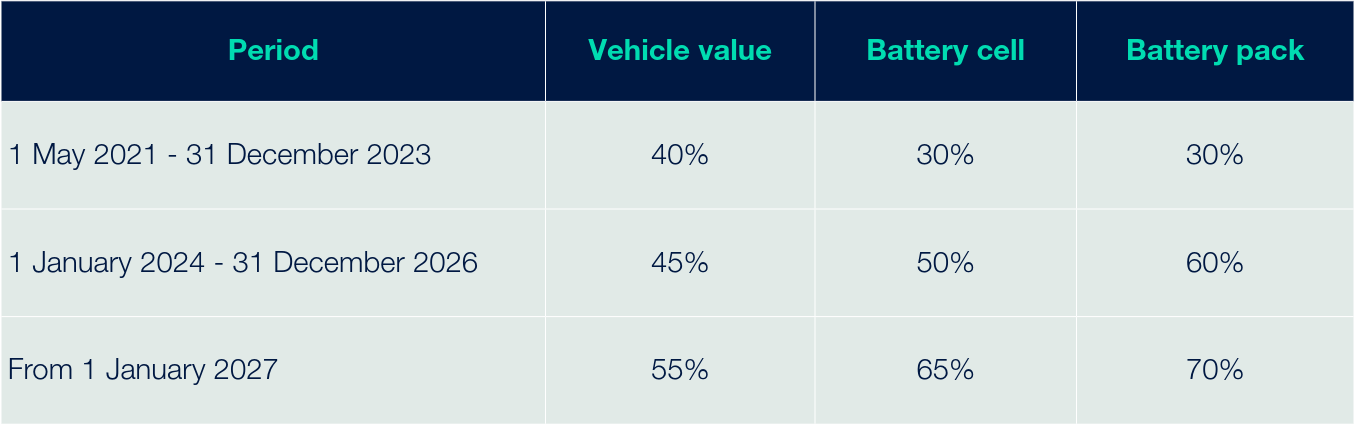
- May 2021 until December 2023: 40% for vehicle value, 30% for battery cells and 30% for battery packs
- January 2024 to December 2026: 45% for vehicle value, 50% for battery cells and 60% for battery packs
- January 2027 onwards: 55% for vehicle value, 65% for battery cells and 70% for battery packs
Battery origin requirements: Why sourcing is the real compliance challenge
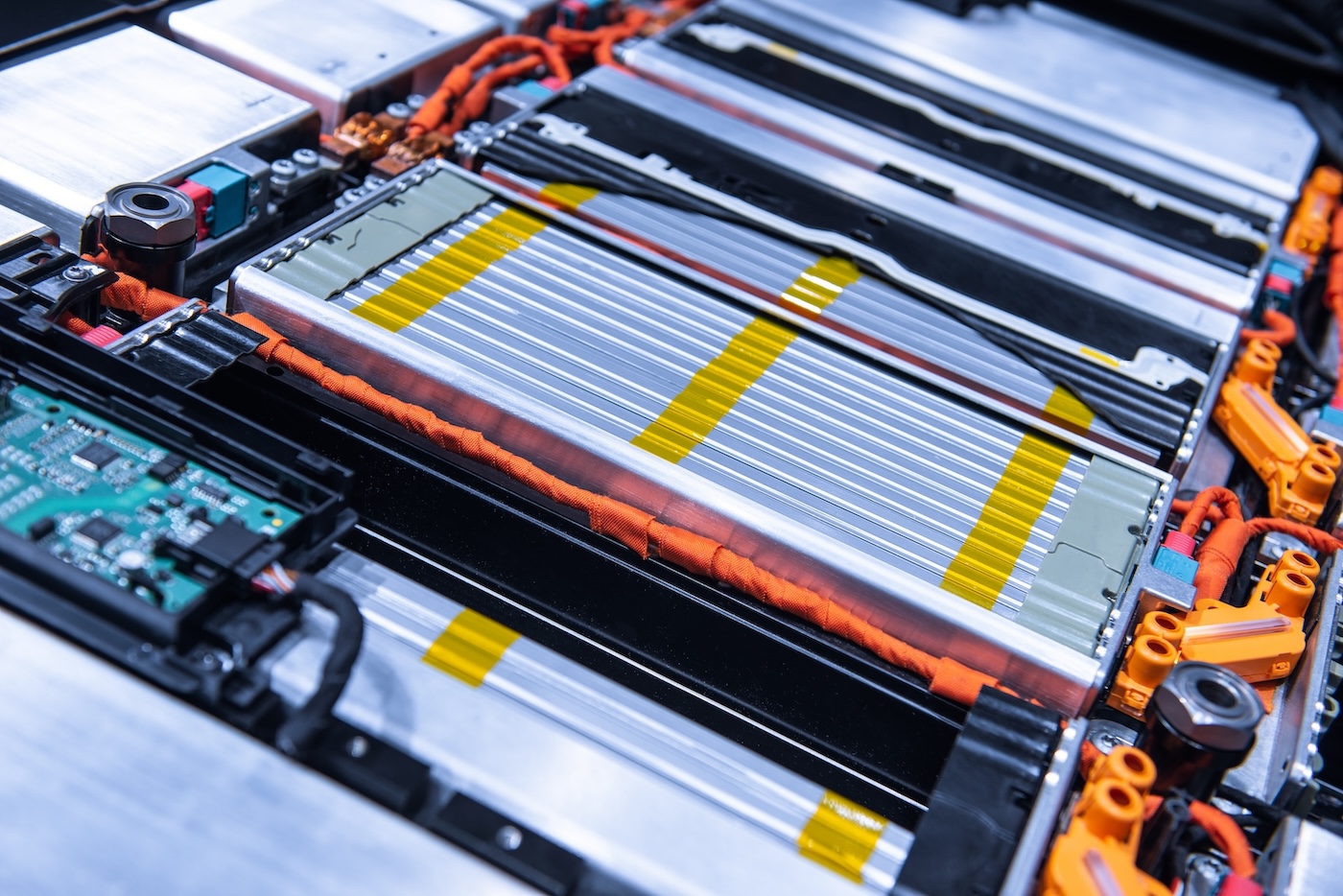
Meeting battery origin requirements is one of the hardest parts of staying compliant for many manufacturers. This is because key battery components and materials are often sourced outside the EU and UK. As local content thresholds continue to increase, sourcing and production strategies will need to keep pace to maintain tariff-free access.
What does this mean for the EV market?
For manufacturers reliant on imported battery cells, that sourcing gap is also a competitive risk – and one that Chinese EV brands with more vertically integrated battery supply chains are well placed to benefit from.
ACEA statistics show that as of 2026, Chinese-made BEVs make up nearly 28% of UK BEV sales, with over 16% being exclusively Chinese brands. Furthermore, consumers are increasingly receptive to new manufacturers.
Our 2026 EV adoption and perceptions report found that among drivers aged 18-24, 25% would consider buying a new market entrant. With new manufacturing plants set to launch across Europe, new opportunities may arise for OEMs as these brands build locally:
- Chinese manufacturers could benefit as more of their own vehicles qualify for tariff-free trade.
- OEMs across Europe could gain access to more diverse Chinese battery technologies as EU-based plants expand.
As supply chains evolve and new brands gain market share, understanding how these changes influence EV residual values will become increasingly important.
How is originating status proven?
To qualify for tariff-free trade under the TCA, the UK government requires manufacturers to formally prove originating status. This typically involves documenting component origins before calculating the percentage of local content within the vehicle.
OEMs take responsibility for formal customs declarations. These apply across the EU, and may need to include:
- An accurate commodity code
- Supplier declarations
- Statements on origin
- Bills of materials
How does the EU-UK TCA affect retailers and OEMs?
When stricter rules of origin requirements are due to come into force on 1 January 2027, electric vehicle manufacturers will need to adapt to supply chain challenges. Retailers are likely to feel the effects in pricing and vehicle availability.
Amid limited EU and UK production of cathode active material (CAM), the battery-cell material hardest to source locally, many vehicles could fail to meet the relevant rules of origin and therefore lose access to tariff-free exports.
Local content requirements: Impact on retailers
For EV retailers, stricter rules of origin could increase vehicle costs where tariffs apply. As the competitive balance between Chinese- and European-built EVs shifts, retailers may need to adapt their pricing strategies.
Some retailers may absorb tariff-related increases to remain competitive, while others may pass these to the consumer. Retailers selling into fleet and leasing channels may notice buyers reassessing purchasing decisions as acquisition costs rise and total cost of ownership (TCO) calculations shift accordingly.
Professionals stocking imported BEVs that do not meet local content requirements may face difficult decisions around higher costs, stocking strategies and vehicle portfolios.
Rules of origin: Impact on OEMs
For OEMs, increasingly strict rules of origin add pressure to localise the EV supply chain within the EU and the UK. Because cells, packs and other components must meet specified battery origin requirements, OEMs may need to reassess their supplier networks and production locations.
Industry concerns about the impact of these changes are not new. In 2023, the ACEA warned that the introduction of the proposed 10% tariff could cut EV production by up to 480,000 units in a three-year period, with potential costs exceeding €4.3 billion.
How are the EU and UK supporting EV battery production?
In December 2023, the EU-UK Partnership Council introduced measures to help the industry adapt and strengthen European battery manufacturing. The Council is a joint body established under the TCA and co-chaired by a European Commission Vice President and UK government minister.
Alongside extending the 2024 thresholds through to the end of 2026, these included:
- The introduction of a fixed mechanism designed to prevent further amendments until at least 2032
- Up to €3 billion in funding to support the EU’s battery industry, provided under the Innovation Fund
Staying ahead of the deadline
As local content requirements are due to tighten from January 2027, rules of origin are becoming increasingly important for businesses involved in the EV market.
Battery sourcing, supply chain transparency and manufacturing locations will play a key role in shaping global competitiveness. Additionally, the industry is still in the early stages of adapting to European battery production. As this opportunity develops, OEMs should monitor regulatory guidelines and market dynamics closely.
Any business planning a long-term EV strategy should understand the implications of rules of origin and how they interact with wider EV legislation, including the ZEV mandate and upcoming Euro 7 standards.
For the latest on EV trends, vehicle sourcing and automotive trade policy news, read the latest insights on the EV Hub by Cox Automotive Europe.
Automotive rules of origin: FAQs
What happens if an EV does not meet rules of origin requirements?
Simply, the importer (typically the OEM) must pay the 10% tariff on each non-compliant vehicle. Where this cost cannot be absorbed, it may be passed down the supply chain and eventually impact retailer pricing.
How many EVs are exported from the EU to the UK?
In 2025, over 290,000 EU-made BEVs were exported to the UK. EV exports already account for more than one in five EU-made exported cars, contributing more than €10.1 billion to the industry.
Do imported battery cells affect an EV's originating status?
Yes. UK-based and European manufacturers face challenges with imported batteries even if the rest of the vehicle is produced locally. This is because the battery accounts for such a large portion of the vehicle’s overall value.
As new battery plants are expected to be built within the EU, it may be possible for OEMs to update originating status on established models.
Are hybrid vehicles subject to the same rules of origin requirements as BEVs?
No. Hybrid vehicles have batteries typically assisted by a petrol combustion engine, whereas BEVs rely solely on the battery as the primary source of power. European law outlines this distinction and sets different corresponding local content requirements for each vehicle type.
How are minimum local content values calculated?
Rules of origin under the TCA are based on a standardised percentage. This indicates the maximum allowed value of non-originating materials (MaxNOM), which is calculated using the following values:
- VNM (value of non-originating materials): The total value of materials sourced outside of the EU and UK. This is typically based on their customs value when imported and may include transport, insurance and packing costs.
- EXW (ex-works price): Describes the sum paid to the producer for the finished vehicle or component. When no sale price is available, this is based on production costs plus a reasonable amount for overheads and profit.
To calculate MaxNOM, the VNM is divided by the ex-works price, and the resulting number is then multiplied by 100.
Euro 7 explained: What it means for the automotive industry
Euro 7 replaces Euro 6 from 2026, adding brake, tyre and battery durability rules. See what changes, when it applies, and how to prepare your fleet.
UK ZEV mandate: What it means for the automotive industry on the road to 2030
Understand the UK ZEV mandate, how it works and what it means for manufacturers, fleets and retailers.