EV vs. ICE: Depreciation and residual values explained

EV residual values and depreciation vary by model and segment and are influenced by evolving technology and policy shifts. However, the used EV market is showing signs of stabilising as battery reporting improves, supply and demand increases and buyer confidence grows.
In this article, we explore how EV and internal combustion engine (ICE) vehicles depreciate differently, what this means to industry professionals, and the outlook for the used EV market beyond 2026. We also include a practical checklist to help fleet operators and retailers maximise resale value.
Key takeaways
- The EV and ICE depreciation gap is narrowing as the used EV market matures.
- Average EV deprecation sits between 38-42% after three years.
- Battery health, vehicle range, charging capability and service history influence EV residual values.
- Consistent maintenance and professional vehicle preparation can help maximise EV resale values.
- EV residual value forecasting is becoming more reliable for industry professionals.
What is EV depreciation?
EV depreciation is the reduction in an electric vehicle’s value over time. Like all vehicles, electric cars lose value as they age and accrue mileage. Understanding depreciation is important because it directly affects EV residual values and total cost of ownership (TCO).
Understanding vehicle value in an evolving used car market
How vehicles hold their value is a crucial question for fleets, retailers and original equipment manufacturers (OEMs). With more EVs entering the used car market, understanding future vehicle values is more important than ever.
Our data shows that buyer confidence is growing thanks to more stable pricing and better battery reporting. However, forecasting remains a challenge as technology, incentives and supply continue to evolve.
EV adoption shows no signs of slowing. With monthly battery electric vehicle registrations increasing by 44.5% year on year, more EVs will be entering the used market. As this volume reaches resale, EV residual values play a crucial role in shaping retail pricing, part-exchange valuations and remarketing decisions.

EV depreciation trends: 2026 data
Early electric models often depreciated faster than comparable ICE vehicles due to market uncertainty, rapidly evolving technology and limited demand.
However, research shows the gap is closing as the market matures and long-term performance improves. Strong second-hand supply from fleet renewals and salary sacrifice schemes has further stabilised depreciation. In the first quarter of 2026, used BEV transactions grew by 32% year on year.
These trends point to greater consistency in the used EV market, with average EV depreciation for November 2025 sitting at 38-42% after three years, compared with 35-40% for petrol vehicles. This provides retailers and remarketing teams with clearer guidance on residual values.
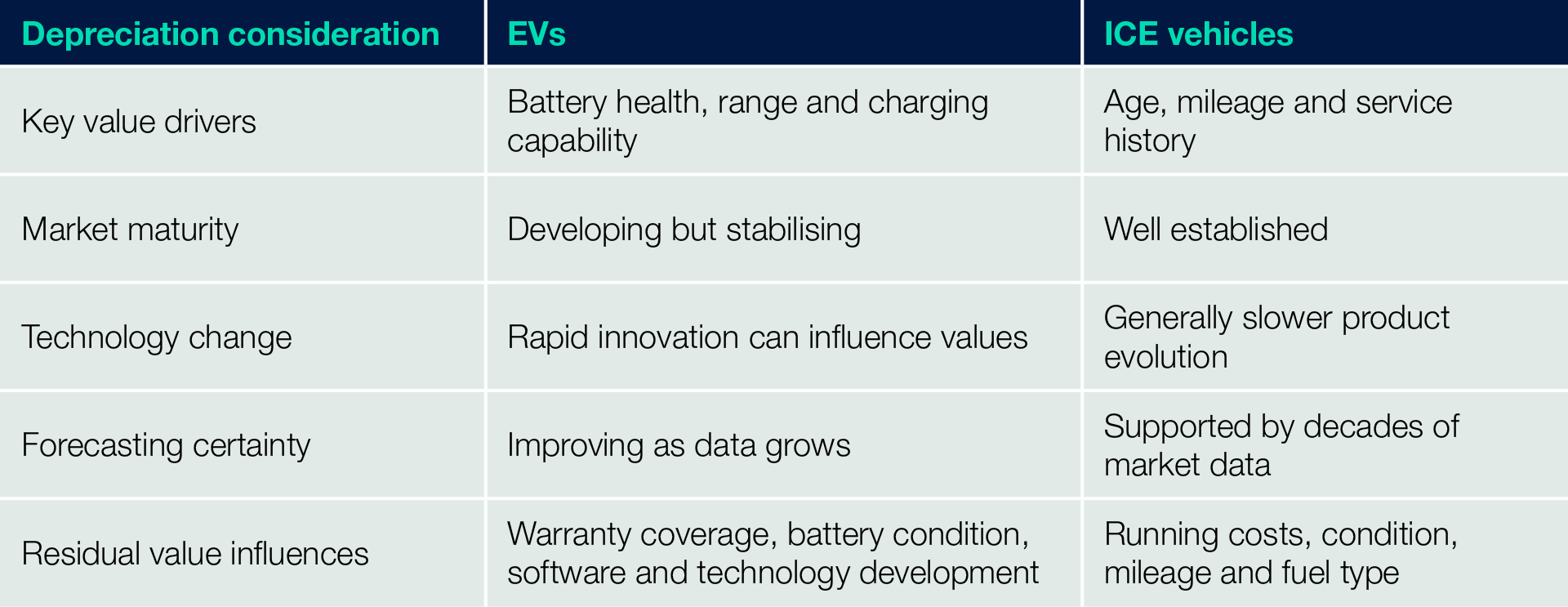
EV depreciation vs. ICE: What's the difference?
EV depreciation
While EV adoption continues to grow, the used EV market remains less mature than the petrol and diesel market. Variable factors make EV residual values more sensitive to change:
- Vehicle range and charging capability can have a greater influence on EV residual values, making forecasting more complex.
- EV values are also affected by rapidly evolving technology and short product cycles, driven in part by increasingly ambitious zero emission vehicle (ZEV) mandate targets.
ICE depreciation
Depreciation patterns for internal combustion engine (ICE) vehicles are well established.
- These vehicles typically experience an initial, sizeable drop in value followed by gradual stabilisation.
- Patterns are supported by decades of market data, often specific to manufacturer and vehicle type.
This allows dealers, fleets and OEMs to forecast residual values with a high degree of confidence and adjust strategic direction appropriately.

EV depreciation: What affects EV residual values?
Battery health and technologies
Battery health remains one of the most significant influences on EV resale values, shaping both confidence and price realisation.
While exterior condition and vehicle specification both matter, buyers increasingly prioritise EV-specific indicators such as state of health (SoH), charge cycle data and previous evidence of responsible charging behaviour. Even small variations in SoH can shift used EV values significantly, particularly in price-sensitive segments.
Charging capability
Charging functionality is an increasingly important contributor to EV residual values because businesses and consumers demand practical long-distance usability. Vehicles capable of optimised charging are attractive on the used market as they offer more day-to-day convenience.
Software updates and range
Up-to-date software and firmware matter, too. Many EVs rely on scheduled updates that improve efficiency, performance and battery conditioning cycles. Vehicles with a verified update history tend to hold their value better, as buyers increasingly factor this into their assessment of overall battery condition.
Vehicle range remains a key consideration for used EV buyers. Models that continually meet real-world driving requirements are typically better positioned to retain value.
Service history and maintenance
Strong maintenance records remain one of the most reliable ways to protect EV residual value. While EVs have fewer moving parts than petrol or diesel vehicles, buyers still expect a complete and verifiable service history.
Missing records, inconsistent servicing intervals or incomplete digital documentation can quickly undermine buyer confidence. The service areas that influence EV resale value most heavily include:
- Battery cooling systems: Thermal regulation maintains battery performance and reduces long-term degradation.
- Tyre condition: Higher vehicle weight and instant EV torque can accelerate wear, making regular tyre inspection.
- Brake maintenance: Regenerative braking can reduce wear, but brakes should still be regularly inspected.
Vehicle condition and presentation
First impressions continue to play a significant role in vehicle valuation.
Regardless of battery condition or vehicle age, cosmetic damage and incomplete presentation can stifle interest. Comprehensive vehicle preparation services support dealers looking to maximise returns.
For fleets and remarketing teams, consistent presentation standards help to boost engagement and support residual value outcomes, no matter the vehicle type.

What does EV depreciation in 2026 mean for industry professionals?
EV residual values are now more closely tied to measurable factors than to uncertainty around battery lifespan and OEM technologies. With depreciation showing signs of stabilising, prior volatility may ease.
This provides retailers, fleet operators and OEMs with a clearer direction when forecasting residual values. While faster product cycles, evolving incentives and policy changes continue to influence the market, EV depreciation is becoming easier to assess than it was only a few years ago.
Why do improved EV residual values matter for dealers?
For car dealers, greater clarity around EV depreciation patterns supports more confident decision-making throughout the sales process:
- More accurate appraisals: Consistent depreciation trends support consistent part-exchange valuations.
- Healthy stock-turn: Growing confidence in future values makes it easier to source and price EV stock.
- Increased market competitiveness: Dealers that can demonstrate reliability and provide consistent valuations are better positioned to compete.
How does stabilising EV depreciation benefit fleet operators?
Balanced EV residual values mean greater confidence in lifecycle planning and whole-life cost forecasting for fleet operators:
- More accurate TCO modelling: Stable EV depreciation makes forecasting easier over a typical cycle.
- Competitive pricing: Stronger residual values may support favourable monthly pricing for fleet operators.
- Lower risk at the defleet stage: Consistent used values help reduce risk when defleeting, particularly as more fleets reach the end of their cycles.
- Better strategic planning: Data-led forecasting supports strategic long-term EV adoption, essential for hitting sustainability targets across mixed fleets.
How do consistent EV residual values support OEMs?
For OEMs, improving residual values provide a link between product quality, battery performance and long-term market demand:
- Stronger finance propositions: Improved residual values can boost competitiveness across PCH, PCP and fleet channels.
- Model perception: EV models with longer range, reliable software support and strong battery performance show the lowest depreciation rates and stand out in the market.
- Confident planning: Greater confidence in EV resale values supports future product, pricing and volume planning decisions.
How to protect EV resale values: A practical checklist for fleet operators and retailers
For fleets and retailers, optimising EV resale values is essential. A consistent process improves sale readiness while protecting returns at both auction and forecourt.
Our EV resale checklist covers the most effective ways to maximise returns:
1. Confirm battery health before sale
- Confirm SoH reading
- Attach battery testing report
2. Update charging and vehicle software
- Ensure firmware is up to date
- Provide proof of recent software updates
- Confirm charging cable type and condition
3. Include a complete service history
- Meet all EV service history requirements
- Include most recent inspection reports
- Provide evidence of tyre/brake checks
4. Check tyres, brakes and consumables
- Check tyres have minimum tread depth and even wear
- Complete a brake system inspection
- Replace wipers, fluids and filters if necessary
5. Improve vehicle presentation
- Complete cosmetic appraisal
- Carry out interior reconditioning
- Commission professional detailing where required
- Package all vehicle documentation clearly
6. Final steps: Optimise your EV listing
- Arrange high-quality photography
- Supply accurate, transparent descriptions
- Align the reserve price with used EV values
- Include battery SoH data on the listing

The road ahead for EV residual values
In 2026, the picture is becoming more balanced. This is due to plateauing range and charging performance, standardised battery health reports and a better understanding of running costs. Despite growing supply and demand in the used market, challenges remain.
The priority for the automotive sector is to continue investing in transparency for consumers and embracing EV insights to build momentum and confidence in the used EV market.
FAQs: EV depreciation and residual values
What has the biggest impact on EV resale value?
Battery health and reporting. As the battery is the most valuable component, its condition is key for prospective buyers. Battery state of health reporting bolsters transparency. Vehicle condition and service history matter too: repairs and maintenance must be recorded.
Do EVs depreciate faster than petrol or diesel cars?
Historically, EVs depreciated faster due to market uncertainty and lower demand, but that gap is has narrowed. Depreciation rates also vary by model: newer, long-range EVs with faster charging typically retain value better than earlier-generation vehicles with shorter ranges.
How much do EVs depreciate after three years in the UK?
Data indicates that the average EV depreciation rate falls between 38-42% after three years, vs. 35-40% for ICE vehicles. While more stable in 2026, it still varies by model and segment.
Is service history important for EV resale?
Yes. While EVs generally require less mechanical maintenance than petrol or diesel cars, a complete and verifiable service history remains highly important for supporting EV resale values.
Which EVs hold their value best?
Generally, larger models with long-range, rapid charging capability, strong brand demand and good battery warranty tend to show the lowest depreciation.

Liam Quegan: EV remarketing – a sector in transition
Beyond the Battery, an EV Battery Solutions mini-series hosted by award-winning motor journalist, Erin Baker.
Helping drivers adopt: A guide to boosting UK EV sales
Discover how EV retail strategies, staff training and consumer education can boost UK EV sales.